
-
Popular search terms
Get the Ultimate Guide
to Applying for an MBA
Download for free
Download you MBA Admissions Guide
Get the Ultimate Guide
to Applying for an MBA
Download for free
Download you MBA Admissions Guide
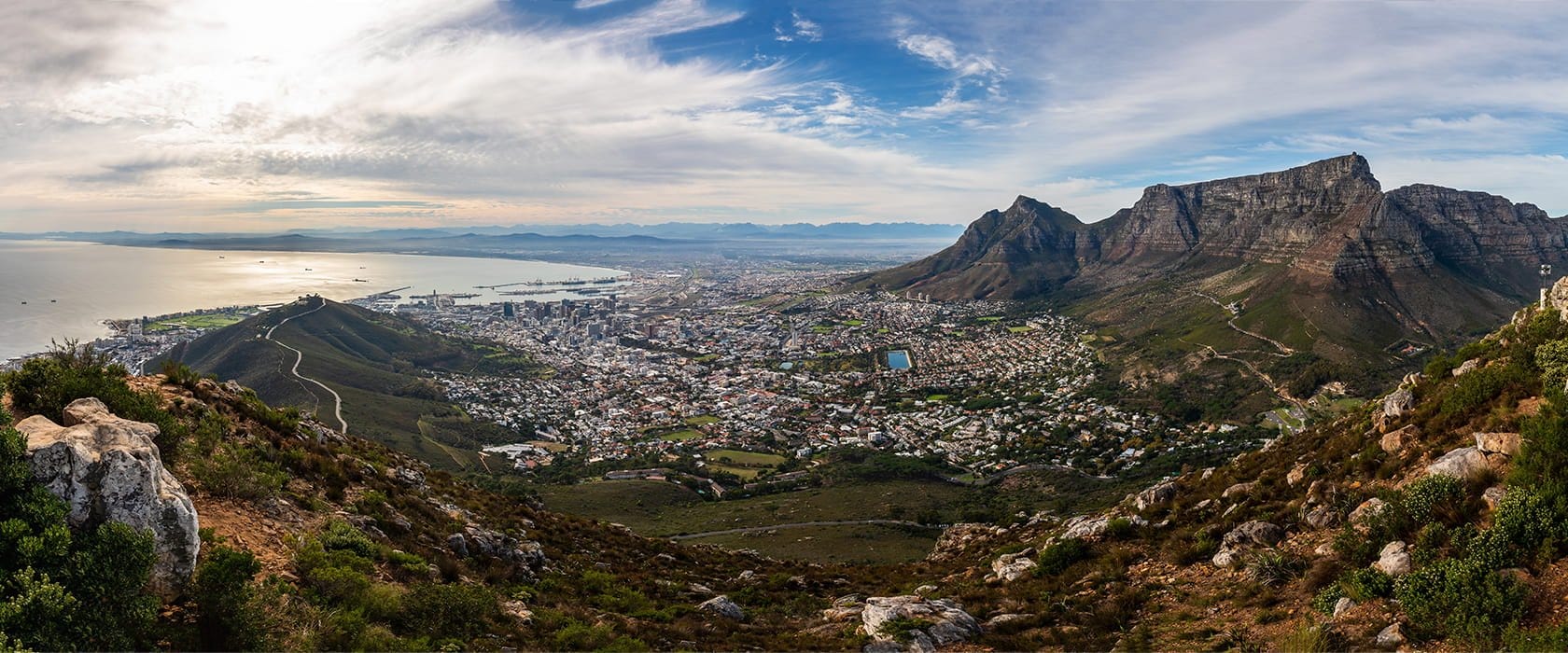
With a dramatic geography that encompasses everything from vast grasslands to golden beaches and a population made up of several distinct ethnic groups speaking 11 official languages, it’s little wonder that South Africa is known as the “Rainbow Nation.” It is the economic driver of Africa and holds a growing influence on the world stage since emerging from apartheid in the 1990s. Millions of tourists flock to South Africa every single year to see the stunning natural geography and wildlife, along with the urban centers of Cape Town, Durban, and Johannesburg. Indeed, South Africa’s cities are all perfect illustrations of the country itself: dramatic, exciting, and with the capacity to surprise.
Given South Africa’s economic and cultural pre-eminence within Africa, it is also unsurprising that the country is a continental hotbed for higher education. It is now the third-most popular international destination for African students behind France and the UK. However, with more affordable tuition fees, cheaper living costs, and universities that are among the global top 200, it is not unthinkable that South Africa will displace those two in the coming years.

International students wishing to do an Master in South Africa must apply for a visa at the South African embassy in their home country. You must submit documents including your passport, a vaccination certificate, proof of sufficient funds, proof of medical cover, and more.
Work visas are more difficult to obtain, as they are only issued to foreigners with relevant, critical skills, not available among the South African citizenry.
If you are completing your Master in South Africa, it can be useful to open a new bank account. The most common student bank accounts are available at banks like Absa, FNB, Investec, Nedbank, and Standard Bank. The required documents are your passport or birth certificate, proof of address, and the acceptance letter from your university. Non-residents need to provide further documents, including three months of bank statements from your home country’s bank.
Opening a new bank account in South Africa can take up to 10-15 working days. Monthly fees range from R10 (US$0.63) to R26 (US$1.64).
The healthcare system in South Africa has two tiers: public and private. The majority (80%) of healthcare in South Africa is public. To apply for public healthcare, you will need to provide documents such as your passport or birth certificate, proof of address, proof of acceptance at your university, and your tax number.
Private health insurance offers more benefits and coverage than public healthcare. However, it is more expensive. To give you an idea, private consultation costs are around R350-400 (US$22-25), compared to around R55 (US$3.47) through public (state) healthcare.
South Africa has a generally high standard of living at a low cost. Many universities in South Africa offer on-campus accommodation for students, in which you can have your own room or live in a shared room. Some student dormitories include meal plans in their cost! Single rooms in a student dormitory usually cost around R46,000-60,000 (US$2,900-$3,800) per year. Shared double rooms, on the other hand, will cost around R43,000 (US$2,700) per year.
International students in South Africa can also choose to live in private accommodation off-campus. Depending on the location and facilities, the price of renting a room ranges from R4,000-25,000 (US$250-$1,600) per month. Note that private accommodation will cost more in Johannesburg, the most expensive South African city, followed by Cape Town, Pretoria, and Durban.
Commuting within urban areas in South Africa is convenient through the use of public transportation like trains, buses, taxis and ride-sharing services, and long-distance coaches. Driving is the most common form of transport for locals in South Africa. However, South Africa has one of the highest carjacking rates in the world. Therefore, for international students, it might be best to consider alternative methods like trains and taxis.
The cost of train tickets averages around R1,122-2,880 (US$70-$182) per month. South Africa boasts Africa’s busiest railway network, and many cities are currently rolling out bus routes to improve travel times and safety. Taxis and ride-sharing apps are also popular in urban areas.
The Big Mac Index was invented by The Economist in 1986 as an informal way of measuring the purchasing power parity (PPP) between two currencies. The price of a Big Mac in South Africa is R39.90 (equivalent to US$2.52, EUR€2.38, and JP¥322). For US$50, you can buy 19 Big Macs.
The cost of living for a single person in South Africa is estimated at around R9,000 (US$568) monthly, excluding rent. Unsurprisingly, the largest cities in South Africa (Johannesburg, Cape Town, and Durban) are more expensive.